
Choosing the proper AI solution was once an easy task. But not anymore. Every month sees thousands of new launches, all promising to cut costs, save hours or eliminate a dull task. Finding the truly useful among the multitude has become such a research challenge that there is no wonder AI solutions marketplaces have grown from rare hobby websites to commonly used tools for many professionals.
The scenario is quite similar across nearly all businesses. The team requires some particular solution, a speech to text service, a document extraction tool, a product photo generator in batches and the journey begins with a Google search. What comes next is a jungle of sponsored links, outdated reviews, and vendor websites that all use the same wording. Comparing pricing models, finding out if the product is still maintained and what other people use it for is virtually impossible.
AI directories and software discovery tools alleviate that friction for you by categorising the apps based on their functionality, industry, job-to-be-done, allowing filtering options based on price and the OS, reducing endless scrolling time down to just a few minutes. From simple handpicked app collections to full-fledged markets that provide an opportunity to try out, buy, or deploy your own models all within the site itself.
In this guide, we’ll dive into ten such platforms, their strengths and weaknesses, and the target audience for each of them.
What Are AI Tools Marketplaces?
In essence, an AI marketplace is nothing but an organised library. The program gathers all AI software into one place, indexes it correctly, and gives you a chance to filter through all the noise without sacrificing your whole afternoon. Think of it more as an interactive library you use for finding an answer to something, rather than some advertisement for some specific product.
The process remains quite similar from one platform to another. The developer or the editor simply adds a tool into the database, categorises it, mentions its pricing model, platforms it works on and sometimes even describes its purposes. After that, the platform gives you all the filters to narrow down your search options for whatever you are looking for, maybe it’s a free video editor with API, or a paid platform that effortlessly processes legal documents.
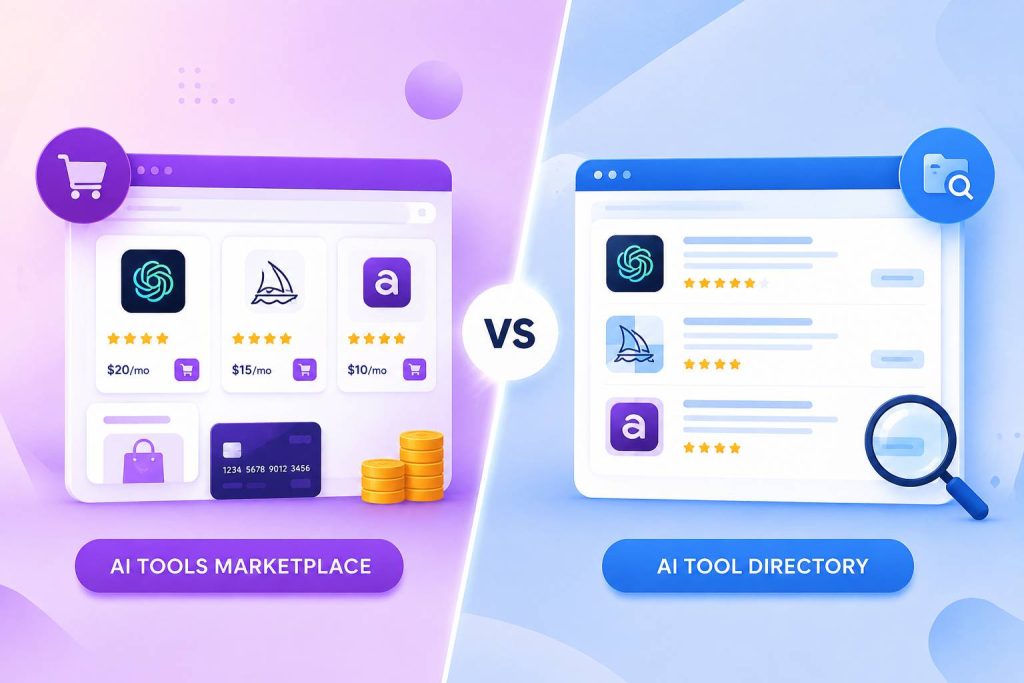
This is where all similarities end. Some sites choose to be merely a catalog, presenting you with information about the product, providing more details and sending you on your way to the vendor’s website in order to do all of the remaining work yourself. But some go beyond the limits and let you try the product right within your browser, do all transactions themselves or even generate the model of the software product for you to see how it works.
And here is where the difference really comes into play. A blog post is a snapshot, one person’s opinion about something written on Tuesday and already being outdated by Wednesday. Marketplace or at least directory is something living, constantly being fed with fresh entries, removing useless links and letting you sort and filter all entries according to your criteria. Blog sorts the entries for you, while marketplace provides you with means to sort them by yourself. One is a photo, while another one is a room.
Why Businesses Need AI Tools Marketplaces
The practical case for using an AI software directory comes down to five things.
Discovering software you would never search for. You cannot search for a tool if you do not know the category exists. Browsing a well-organised directory surfaces things like meeting intelligence, synthetic data generation or retrieval pipelines that never occur to most people until they see them listed next to something familiar.
Comparing alternatives properly. Nearly every popular AI product has five or six credible competitors, some of them cheaper and better suited to a specific task. Directories with alternatives pages make that comparison possible without opening twenty tabs.
Finding niche and industry-specific tools. General search engines are dominated by the biggest marketing budgets. A directory with proper category depth is far better at surfacing the small tool built specifically for veterinary practices, warehouse routing or academic citation checking.
Saving research time. This is the honest, unglamorous benefit. A shortlist that takes ninety minutes to assemble by hand takes about ten minutes on a good AI discovery platform. For agencies evaluating tools on behalf of clients, that difference compounds quickly.
Keeping pace with the market. New releases, model updates and pricing changes arrive constantly. Following two or three directories, or their newsletters, is a low-effort way of staying reasonably current without reading launch announcements all day.
Look for industry-specific tools
As search engines favour products that invest heavily in marketing, finding industry-specific solutions becomes increasingly challenging. AI marketplaces classify tools based on industries they serve, making it possible for companies to look for solutions designed specifically for industries like healthcare, education, law, manufacturing, logistics, and finance.
Save time on research
Finding the right software manually takes many hours of browsing, reading reviews, and evaluating websites. The process is significantly streamlined when using AI marketplaces, as all necessary information is found in one place and the list of viable options is created much faster.
Stay updated of an ever-changing market
An AI market is continuously changing due to the launch of new products, feature updates, and changes to pricing models of the current solutions. With regular updates to AI marketplaces, staying informed about market changes becomes more manageable.
How We Chose the Following Platforms
There are literally hundreds of AI directories on the web, and many of them are very basic affiliate sites whipped up in a weekend. The ten listed below were evaluated based on a common set of standards.
- Number and quality of database entries : Big enough to be useful and have categories other than the most obvious ones.
- Frequency of updates : Showing that new tools are consistently added and dead tools deleted.
- Searching and filtering : Filters for price, category, platform and use case, not just searching via keywords.
- Structure of categories : Logical categorisation that follows how the problem is described.
- Credibility : An ability to separate sponsored links from editorial ones, when that is possible.
- Usability : Fast load times without annoying interstitials.
- Industry scope : Relevance outside of marketing and content, where most directories focus.
- Community engagement : Upvotes, saves, reviews or discussions that provide additional context for a listing.
- Quality of listings : Explanation of what a tool does instead of rehashing its tagline.
None achieves excellence in all nine dimensions. However, each of the ten websites listed below does something well enough to earn a bookmark and their reviews make that weakness very clear.
- What Are AI Tools Marketplaces?
- Why Businesses Need AI Tools Marketplaces
- How We Chose the Following Platforms
- 10 AI Tools Marketplaces Every Business Should Know
- 1. inode AI
- 2. Futurepedia
- 3. There’s An AI For That
- 4. AI Tools Directory
- 5. AI Tools FYI
- 6. AIxploria
- 7. All Things AI
- 8. AppSumo
- 9. Hugging Face Spaces
- 10. Toolify
- Comparison Table
- Which AI Marketplace Is Best for Different Users?
- Tips for Choosing an AI Tools Marketplace
- Common Mistakes Businesses Make When Choosing AI Tools
- Future of AI Tools Marketplaces
- Final Verdict
- Frequently Asked Questions
- What are AI tools marketplaces?
- Are AI tool directories free to use?
- How accurate are listings on AI marketplaces?
- Which platform is best for finding free AI tools?
- Can I find industry-specific AI tools on these platforms?
- What is the difference between an AI directory and an AI marketplace?
- How often should I check AI tools marketplaces?
- Are paid AI tools always better than free ones?
- Do AI tools marketplaces review the software they list?
- Should I use more than one AI tools marketplace?
10 AI Tools Marketplaces Every Business Should Know
1. inode AI
Inode AI follows an altogether different path from other entries on this list. Unlike the rest of the entries, inode AI not only functions as a directory for links but as a marketplace for listing and trading of AI products and machine learning models. The directory consists of a product directory, a separate section for AI tools, a feed page for organisations to post AI projects and tooling for model owners wishing to monetise their model.
This dual approach alters what can be done at the directory. Whereas at an ordinary directory you just visit the website and use the link, here the deal takes place on the site itself and becomes convenient when what you require is not a subscription to a SAAS application but a custom-made AI product.
- Features: Comprehensive list of AI products; ability to commission a custom AI solution using a project and bounty marketplace; ways to monetise your models for developers; enterprise-oriented features; good documentation for companies implementing AI technology.
- Industries covered: Many industries including manufacturing, operations, software development, analytics and enterprise use cases with an emphasis on practical applications of AI and machine learning technologies instead of consumer-oriented solutions.
- Advantages: In contrast to other AI directories which concentrate only on the process of discovery, this website offers services that are needed after the discovery stage. Businesses can order custom AI projects and developers can monetise their models.
- Weaknesses: In comparison with other AI directories this site provides a smaller list of solutions and a less developed community which means a lack of user ratings and reviews.
Suitable for: Companies that want to find, buy, or develop AI solutions and also developers who would like to monetise their AI algorithms rather than just promote them.
Official Website: inode-ai.com
2. Futurepedia
Futurepedia has been one of the most used directories for AI tools ever since the first generation of generative AI products was launched. What makes it stand out the most is the structure of the site. The categories are easy to navigate, sorting by price and tool type is easy, and there is enough information in every description to give a user an idea of whether the product is worth investigating further.
Apart from having a large selection of tools on the site, Futurepedia offers tutorials, comparisons, and a newsletter service. This content helps a user to get familiar with a new category of AI products.
It offers strong coverage in marketing, design, video production, productivity, and software development. If your business focuses on any of these topics, then you’ll be able to find plenty of useful tools. On the other hand, if you use specialised fields such as logistics or clinical research as keywords, you will get fewer results. The website mainly offers writing assistants, image and video generators, social media tools, analytics services, and no-code automation services.
You can find sponsored and featured items on the website. Although all of them are marked as such, they affect the position in search results, and thus the top items are not always the best options. Moreover, some of the tool descriptions are quite short and are similar to vendors’ advertising materials.
Suitable for: Marketers, freelancers, content creators, and anyone interested in learning about AI tools and finding educational materials. A perfect starting point to explore a particular topic.
Website: futurepedia.io
3. There’s An AI For That
Such a platform became popular due to just one idea: allow users to look for applications based on the task that should be performed, not on the classification of the application itself. The users say what they need, and they get proposals about applications that can solve the problem. This is much simpler for those users who do not know anything about the technical details of the classification.
The database has a very extensive database consisting of tens of thousands of applications with a huge diversity of use cases. Community signals like saves and votes show what people return to, partially helping to overcome the trouble with browsing through such a vast catalogue.
But scale is the biggest flaw of the site. The large database is sure to include abandoned products, almost identical models with minor changes in presentation, and long-neglected items. Some filtering and analytics options are accessible in the paid version. The coverage in industry is extensive, but quite varied, covering all spheres except regulated industries.
Strengths in short:
- Task-based search aligning with how lay users think
- Extremely broad scope covering unusual and very specialised scenarios
- Quality signal in popularity information
Suitable for: Exploratory research and problematic requirements that do not easily fit into any particular category. This is the search engine to use when you know the goal of the software but don’t know the name of the product itself.
Website: thereisanaiforthat.com
4. AI Tools Directory
Not all situations demand thirty thousand listings in a database. AI Tools Directory is a smaller, more focused site which works best for those who simply need to peruse through the various categories and select one of the more manageable numbers of offerings.
Its design is simple. It features clearly outlined categories, short functional descriptions for each listing, and not much more before the direct outbound link. As such, it is better suited for a fellow who has no experience using an AI directory at all.
Coverage includes everything that one would expect from such a site, writing, picture creation, audio manipulation, productivity software, development tools, and business management applications. Creators have the ability to list their own offerings, and as such, there is always new content getting added in.
Relevance within the industry tends to be towards small business, educational purposes, freelancing, and office productivity tools in general. Tool types include summarisers, picture generators, chatbots, transcription tools, and scheduling assistants.
Where it falls short: It is notably shorter compared to the industry leaders, has minimal editor’s notes, and lacks sufficient reviews or other information to make it easy to tell one similar choice from another.
Suitable for: scanning categories quickly and for students or small teams who don’t need a lot of choices, but rather need to narrow down their choices. Use it as a shortcut.
Website: aitoolsdirectory.com
5. AI Tools FYI
The main strength of AI Tools FYI is its search and comparison nature. It starts with a prominent search field at the interface and allows filtering results by categories and pricing with a minimal number of clicks.
The most useful element is the focus on alternatives. If one uses some particular software and wants to know what other products perform the same function but perhaps with another price tag or license, the page on alternatives is a quick way to put together such a list. Such discussions often begin right there.
The catalog includes content creation, design, development, business, and productivity software. The descriptions are brief and clear but not very detailed. The industries include software, e-commerce, media, and professional services, which are all digital. The tools include writing, translations, coding assistants, image editing, chatbots and data extraction, among others.
Limitations: The editorials are limited, which means that you get the “what” but not necessarily the “why.” There is no testing done independently to back up the listings, and industry coverage beyond the standard categories is inconsistent. Because of how dependent the listings are on submissions, there are a number of tools that are not included.
Suitable for: Someone who already knows the product that he or she wants to try out before buying. Useful for agencies creating an option list for clients requesting something more economical than the clear market leader.
Website: aitools.fyi
6. AIxploria
Another directory that was not born in the U.S., and which it reflects, is AIxploria. The website can be accessed in a variety of languages and provides more prominence to European products than its peers.
There are two unique elements to this directory. First, there is a regularly updated feed of new products. This feature provides an opportunity to quickly check out all the latest releases from this week. Another interesting element is that there are ranked lists of categories that provide some indication of the popularity of tools before you explore them further.
The categories range from text, images, videos, audio, coding, and business to less mainstream ones.
Trade-off: entries are brief, one or two lines at the most, making it more a discovery method than an evaluative method. The translation quality varies, and the ranking results in popularity, not any kind of evaluation.
Suitable for: Keeping on top of latest releases and non-English speaking product teams who have trouble using other directories. Anyone trying to create a competitive analysis of the category will find it invaluable to see how fast new players show up here.
The reason to keep it open alongside the comprehensive directory is timing. Comprehensive directories need some time to list out all new products, so a feed that focuses on the new releases serves that purpose well. Agencies and product teams benefit from it the most.
Website: aixploria.com
7. All Things AI
All Things AI has had a longer lifespan than most of the directories available at present and continues to maintain a selective indexing approach. Instead of accepting all submissions, it offers a selective index according to category and applications.
Consequently, a reduced number of listings are presented here, which means that the probability of finding something useful is higher. In the case of All Things AI, there is no need to sift through fifteen products that are almost identical in order to discover something worth trying out. Those who find too many listings on large directories to be overwhelming would consider this aspect to be its main strength.
There are fewer advertisements here and the descriptions are written for human readers, not compiled from vendor material. They include applications related to business, customer service, creativity, productivity and software development, which can be considered proven after a long enough period of time.
Limitations: Curation has its downsides. The latest or niche software will never show up, and updates will happen less often compared to those on the automatic and submission-based sites. This is definitely not where you should be if you want to see what has been released recently.
Suitable for: People who like to keep things curated over comprehensive, and for those who have to compile their own set of software. It complements the bigger list of AI software very well.
Website: allthingsai.com
8. AppSumo
It’s important to note that AppSumo is definitely not a directory, and this is the reason it makes sense to include it on the list. Indeed, AppSumo is a marketplace for software deals, and most of the products it offers at the moment are AI-powered solutions. What you get there is not a description but a chance to purchase a certain tool, often once only for a fixed price.
There are a few advantages to using this platform both for evaluation purposes and purchases. Customer reviews are included in the listings and are verified by the company. One gets enough time to try out a tool thanks to refund periods. Prices are transparent, and lifetime deals allow building a whole stack very cheaply.
One may find writing assistants, video and audio editors, SEO solutions, design tools, chatbots, analytics and automation platforms, etc.
Things to look out for: the products listed in the catalogue will be those that the vendors have discounted rather than the entire marketplace, which means the usual suspects are unlikely to feature. Products may be at an early stage of development, and lifetime discounts depend on the strength of the vendor. Roadmaps may slow down after discounts end.
Suitable for: Startups, individual entrepreneurs and smaller agencies that have a budget and want vetted, refundable software rather than links to try before buying.
Website: appsumo.com
9. Hugging Face Spaces
Spaces is the most technically oriented item in the collection, and it is also the most insightful. This site is home to live demonstrations of machine learning models created by researchers, firms, and individuals that can be used right in the browser.
This difference from every other site in the collection is crucial. Other sites offer descriptions of the capabilities of a tool. On Spaces, you can run the model on your data and get an output, which often shows the code behind it as well. For someone who needs to figure out whether a particular approach works before devoting resources to implementing it, that is definitely helpful.
Coverage includes areas outside of the standard commercial offerings, like speech recognition, computer vision, biomedical research, document understanding, translation, and time series.
Realistic limitations: Most of the Spaces are examples rather than applications. There are no support contracts, uptime guarantees, and free versions may queue when busy. Some projects might get dropped halfway through development. The task of turning a successful Space into an application involves engineering work.
Suiteable for: Developers, data engineers, researchers, and non-technical founders looking to validate their capabilities before purchase. It will be tougher for non-technical users than all other platforms mentioned here.
The reason it deserves a place on this list, despite being different from the other directories, is simple: evidence. Most platforms tell you what a product claims to do. This one lets you see what a model actually produces.
Website: huggingface.co/
10. Toolify
Toolify offers both a comprehensive multilingual database and its unique approach to content presentation. In addition to category browsing, it provides ranking pages where it estimates traffic and, in some cases, earnings for its tools.
These figures should be taken with a grain of salt as they are not reported but estimated based on third-party resources. However, when used responsibly, these estimates give an answer to a question that no other directory can offer, is this product really used by anyone, or it just has a good landing page. The context matters when conducting market analysis.
Toolify also has alternative pages, GPT listings, category rankings and multilingual user interface which enables using the platform by non-English speaking teams. The categories include everything from marketing, sales and design to education, finance,healthcare-related tools and developer tools, making Toolify one of the widest catalogs out there.
Downsides: The site contains many ads, and it takes time and effort to browse through the information on offer. The number of entries allows one to expect high variability, so the ranking should guide your decision-making process.
Suitable for: Analysts, entrepreneurs, and marketing people looking to study a competitive area, as well as international teams that require an AI tools library that does not assume English as default language. If the task of convincing someone of the safety of one particular tool versus another is part of your work description, numbers come in handy.
Website: toolify.ai
Comparison Table
| Platform | Best for | Categories | Free/paid | User friendly | Unique strength |
| Inode AI | Buying, selling and commissioning AI solutions | Enterprise, machine learning, business operations | Free browsing, paid products and plans | Moderate | Transactional marketplace with model monetisation |
| Futurepedia | General discovery with learning material | Marketing, design, video, productivity, coding | Free, some paid features | High | Clean taxonomy plus tutorials and newsletter |
| There’s An AI For That | Task-based exploration | Very broad, thousands of use cases | Free, paid tier for extras | High | Search by the job you need done |
| AI Tools Directory | Fast category scanning | Writing, image, audio, business, development | Free | High | Simple layout with minimal friction |
| AI Tools FYI | Comparing alternatives | Content, design, developer, productivity | Free | High | Alternatives pages for shortlisting |
| AIxploria | Tracking new releases | Text, image, video, audio, coding, business | Free | Moderate | Multilingual with a live new tools feed |
| All Things AI | Curated shortlists | Business, creative, productivity, development | Free | High | Selective listings over raw volume |
| AppSumo | Buying tools on a budget | Marketing, SEO, design, automation, video | Paid, deal based | High | Verified reviews and refund windows |
| Hugging Face Spaces | Testing models directly | Vision, speech, NLP, research, data science | Free tier, paid compute | Low to moderate | Run live models before you commit |
| Toolify | Competitive and market research | Broad, multilingual coverage | Free, paid listings available | Moderate | Traffic and ranking data on listings |
Which AI Marketplace Is Best for Different Users?
Startups
In the case of startups, budget and speed take precedence. AppSumo serves as a great platform to find lifetime deals to lower software expenses, whereas Futurepedia can be helpful to explore various categories prior to making a purchase. If you use AI in your own product, then inode AI could be used to license the AI components or even create custom ones.
Developers
Hugging Face Spaces will be the best starting point because it lets you test your model’s behavior with actual input without spending too much time on integration. Combine it with a more extensive catalog like AI Tools FYI when searching for a ready-made API instead of a model that can be fine-tuned. When you already have an AI model that you want to monetise, there is inode AI for that.
Marketing Agencies
These firms assess artificial intelligence technologies at all times and often do so on behalf of their clients, who vary by budget and needs. Futurepedia provides one of the best assessments of tools pertaining to marketing, whereas AI Tools FYI helps quickly find affordable substitutes to an existing suite of tools used by a particular client.
Students
Affordability becomes the most important part for students. Both “An AI for That” and “AI Tools Directory” will help in finding free AI tools. Also, “Hugging Face Spaces” provides an opportunity to try out sophisticated AI models without purchasing powerful computational resources. First, use the directories to find simple tools, and when you get a bit acquainted with AI, try out “Hugging Face Spaces.”
Researchers
The best option for researchers will be Hugging Face Spaces because of its support of model cards, datasets, and open-source code. AIxploria would also be helpful in discovering new AI tools created especially beyond English-speaking regions. However, general business directories won’t be very helpful as they tend to overlook research-oriented projects.
Content Creators
There is a great plethora of AI tools for text, images, videos, and audio creation available for content creators, hence the need for efficient filtering is inevitable. Futurepedia and AIxploria both offer excellent coverage in creative tools, whereas AppSumo provides editing, design, and content repurposing software on very affordable terms.
Business Owners
SMEs would usually prefer a practical solution without having to spend time analysing several hundred solutions. While All Things AI offers a selected list of solutions, AI Tools Directory simplifies the decision process. In case you need custom AI solutions, inode AI is a more appropriate choice for you compared to any other AI directory.
Enterprises
Choosing enterprise software goes far beyond finding out about AI technologies. The process of security assessment, procurement, compliance considerations, and systems integration are equally important. inode AI is especially fit for enterprise AI solutions and customised products.
On the other hand, Hugging Face Spaces helps with the technical assessment of a vendor, and insights from Toolify can offer some additional context in vendor comparison.
Tips for Choosing an AI Tools Marketplace
- Try several different platforms: Each AI directory has something unique about itself. Making comparisons between the tools listed on two platforms will most likely yield better decisions.
- Look at the date of the last update: Since software evolves rapidly, an older directory might be already outdated.
- Be careful about sponsored listings: Promoted tools are simply advertisements. Make sure that you do not settle for the top of the list alone.
- Select the platform for the task: Directory websites should be used for finding new tools, alternatives websites to compare, and marketplace websites for purchasing.
- Focus on quality rather than on quantity: In many cases, having a carefully selected directory containing only relevant tools will prove to be more useful than having a large number of tools with little to none useful information.
- Double-check prices on the vendor’s website: The listing of the tool on the directory might be outdated.
Common Mistakes Businesses Make When Choosing AI Tools
- Selecting based on popularity: Popularity is not a factor that will ensure the best selection of the software for your needs.
- Ignore the privacy of the data: It is important always to consider the data management policies implemented by the vendors.
- Neglects integrations: A very powerful tool that is not able to integrate into your current processes can become a headache.
- Pay attention to low prices instead of stability and reliability: The cost may be important, but you should remember that the software will be a part of business processes.
- Selecting several similar tools: This decision will cause additional expenses and decrease the effectiveness of operations of your company.
- Testing only ideal scenarios: Evaluate AI tools using real-world data and complex use cases to understand how they perform in practice.
Future of AI Tools Marketplaces
AI marketplace technologies are evolving beyond basic keyword-based search. More advanced marketplaces support natural language search, letting users explain what kind of task or business problem they want to solve rather than looking for something specific by categories. Personalised recommendation engines are also emerging, providing users with recommended AI tools based on industry, software stack they use, and past behavior.
Moreover, the appearance of AI agents represents another change that can be expected. While AI products were mostly represented by single-purpose solutions, with increasing complexity of the technology, we can see multi-step workflows being powered by AI algorithms. As a result, marketplaces will have to focus on highlighting capabilities, integrations, permissions, and automation of AI solutions.
Furthermore, specialised AI marketplaces are going to emerge due to the increasing demand for such services in particular industries. Healthcare, legal, finance, and educational sectors, for example, will demand certain AI solutions tailored specifically to their needs. Finally, we can expect better workflow integration, where users will be able to discover, test and integrate with AI solutions from a single platform.
Final Verdict
There isn’t a single AI tools marketplace that encompasses the whole market, and no platform can suit everyone’s needs. The ideal way is to use two or three different platforms depending on what you aim to achieve whether searching for new tools, comparing them, evaluating their technical capabilities, or purchasing software that includes AI.
For general browsing of the AI ecosystem, you will find that there’s nothing better than Futurepedia and There’s An AI For That. Meanwhile, if you want to narrow down your list, then curated platforms and comparison-oriented directories can do the job. Platforms that provide you with a demonstration of the AI models will give you additional technical insights over listing sites.
The main point to keep in mind here is that an AI marketplace should assist in cutting down your search time, not eliminating the need for due diligence. You must make sure you have verified the price, security, data protection, integration capabilities, and vendor support before buying the software.
Frequently Asked Questions
What are AI tools marketplaces?
AI tools marketplaces are online marketplaces that help users explore, compare, and assess AI software all in one single place. They classify tools according to categories, industries, pricing, and use cases. They can either function as directories pointing users to the vendor’s website or offer users the capability to purchase, test, and even deploy the AI software.
Are AI tool directories free to use?
Almost all AI tool directories are free for browsing. Their money usually comes from sponsored listings, affiliate relations, and paid entries of software vendors. Some of these platforms offer additional paid options like filters and analytics. It is necessary to know how these platforms earn their money before trusting their rankings.
How accurate are listings on AI marketplaces?
The quality of listings will vary based on platform. In some cases, listings are written by sellers, while in other cases, they are edited by editors. Information about price and features may be outdated since changes happen very often. Marketplaces should be used to make a short list, but then check the information directly on the seller’s website.
Which platform is best for finding free AI tools?
Many AI markets provide the opportunity to search for free products, which makes it convenient to try something new without investing money. When searching for an open source product or a technical demonstration, special websites will come in handy as well. Don’t forget to visit the provider’s website since free packages are updated frequently.
Can I find industry-specific AI tools on these platforms?
Yes, but there will be different coverage levels. General marketplaces specialise in trending areas like marketing, design and productivity, whereas specialised industries will not have many products to choose from. If you require AI tools for specific industries like medicine, law or manufacturing, combine general and specific marketplaces.
What is the difference between an AI directory and an AI marketplace?
AI directories assist the user in finding and comparing software through connections with external vendors. AI marketplaces take this a step further as they allow actions such as purchasing, licensing, deployment, or even commissioning of AI services. There are many modern platforms that incorporate aspects of both of these.
How often should I check AI tools marketplaces?
Checking the AI marketplaces at least once a month should suffice for most companies to stay abreast of the latest releases and developments. Companies that work in rapidly changing domains like generative AI and code assistants may prefer a higher frequency of checks or subscriptions to the marketplaces.
Are paid AI tools always better than free ones?
No. There are many free AI software programs that do an outstanding job. Most of the time, paid programs have more features and better security than free ones. However, it all comes down to personal preference and needs.
Do AI tools marketplaces review the software they list?
Very few marketplaces conduct in-depth independent evaluations, and most list AI solutions. Some of them give editorial opinions or community ratings, whereas others depend more on information provided by vendors. While user reviews and rankings may help you, they should not serve as your primary guide to choosing an AI solution.
Should I use more than one AI tools marketplace?
Absolutely! Each market is characterised by its unique advantages, product types, and business collaborations, so it is impossible to find all that is needed on one marketplace. Choosing two or three proven marketplaces will help you compare your options better and choose the right software products.