If you have tried to find new AI software recently, you have probably noticed the problem: there are thousands of tools, new ones appear every week, and most of them claim to solve the same handful of business problems. Some promise to write your marketing copy, others to automate your customer support, and a good number simply repackage the same underlying model with a different interface.
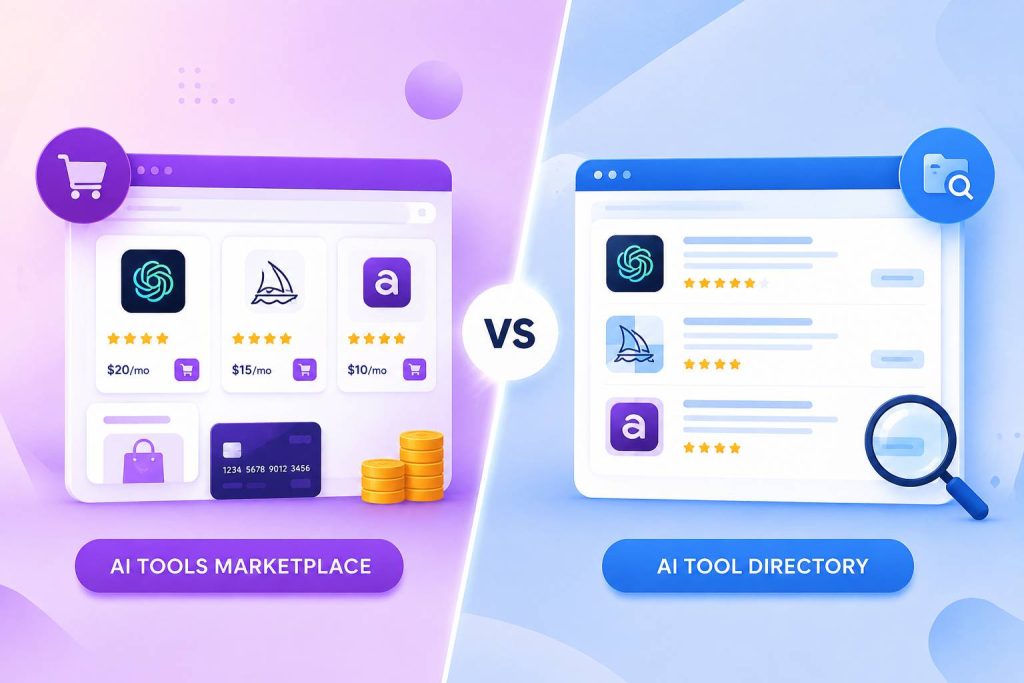
To make sense of this, most people turn to one of two types of platforms: an AI tools marketplace or an AI tool directory. Both aim to help you find software faster. Both list large numbers of AI products. But they are not the same thing, and using the wrong one for your situation can waste time you don’t have.
This article breaks down what each platform actually does, where they overlap, where they differ, and how to decide which one fits your current need. It is not about finding the biggest list of tools. It is about finding the one that actually solves your problem.
- What Is an AI Tools Marketplace?
- What Is an AI Tool Directory?
- AI Tools Marketplace vs AI Tool Directory: Key Differences
- Are AI Marketplaces Better Than AI Directories?
- When Should You Use an AI Tools Marketplace?
- When Should You Use an AI Tool Directory?
- How to Choose the Right AI Tools Marketplace
- What Should Businesses Look for When Finding AI Software?
- AI Tools Marketplace vs Directory: Which One Is Right for You?
- Final Thoughts
What Is an AI Tools Marketplace?
An AI tools marketplace is a platform built around comparison, evaluation, and often transaction. Rather than simply listing tools, a marketplace usually organises them by category, vendor, pricing model, and use case, and gives you the information needed to weigh one option against another.
A typical AI tools marketplace includes:
- Structured categories (writing, coding, image generation, customer support, and so on)
- Vendor profiles with details on the company behind the tool
- User reviews and ratings
- Pricing breakdowns, including free tiers, subscription plans, and usage-based costs
- Integration information, such as which tools connect to Slack, Zapier, or common CRMs
- Side-by-side comparison features for shortlisting options
- In some cases, the ability to purchase, subscribe, or trial a tool directly through the platform
The defining feature of a marketplace is that it is built for decision-making. You are not just browsing what exists; you are comparing options against specific criteria, whether that is price, features, reviews, or vendor reputation.
Some marketplaces function closer to an app store model, where tools can be tried or purchased on the spot. Others are closer to a comparison hub, where the actual purchase still happens on the vendor’s own website.
What Is an AI Tool Directory?
An AI tool directory serves a different purpose. It is primarily a discovery resource, a large, organised list of AI software grouped by category, function, or industry. The goal of a directory is coverage rather than comparison.
Common features of an AI tool directory include:
- Broad categorisation (by task, industry, or use case)
- Search and filter options to narrow down long lists
- Short tool descriptions explaining what each product does
- Basic ratings or popularity indicators
- Links out to each tool’s own website
Directories tend to be useful when you don’t yet know exactly what you’re looking for. If you are exploring a new category, such as AI tools for video editing or AI tools for legal research, a directory gives you a wide view of what exists without immediately pushing you toward a purchase decision.
The trade-off is that directories usually offer less depth. You get a name, a short description, and a link, rather than detailed pricing, integrations, or vendor background.
AI Tools Marketplace vs AI Tool Directory: Key Differences
The clearest way to understand the difference is to compare them side by side across the factors that actually matter when you’re choosing software.
| Factor | AI Tools Marketplace | AI Tool Directory |
|---|---|---|
| Purpose | Compare and evaluate tools | Discover the breadth of what’s available |
| Tool discovery | Curated, often smaller selection | Large, broad selection |
| Categories and filtering | Detailed, often multi-layered | Usually simpler, broader categories |
| Reviews and ratings | Common, often detailed | Sometimes present, often basic |
| Pricing information | Usually included and comparable | Often missing or inconsistent |
| Vendor information | Detailed profiles | Minimal or none |
| Purchasing options | Sometimes available directly | Rarely available directly |
| Tool comparisons | Built-in comparison features | Limited or absent |
| Integrations | Frequently listed | Rarely detailed |
| User experience | Structured for decision-making | Structured for browsing |
| Best use case | Narrowing down a shortlist | Exploring an unfamiliar category |
Neither model is inherently better. An AI tools marketplace and an AI tool directory are simply built to answer different questions. A marketplace answers “which of these should I pick?” A directory answers “what’s out there?”
Are AI Marketplaces Better Than AI Directories?
Not necessarily, and the honest answer depends on what you’re trying to accomplish at that moment.
If you already know the category of tool you need, say, an AI writing assistant, and you want to compare three or four realistic options on price and features, a marketplace will usually save you time. The comparison work has already been done for you.
If you’re at an earlier stage, still trying to understand what kinds of AI tools even exist for a given problem, a directory is often more useful. It won’t do the comparison for you, but it will show you the range of options before you narrow things down.
There’s also a middle ground worth mentioning. Some platforms blend both approaches, offering directory-style breadth alongside marketplace-style comparison features. In practice, though, most tools lean more heavily toward one model than the other, so it helps to know which one you’re actually using.
When Should You Use an AI Tools Marketplace?
A marketplace tends to be the better choice in more decision-focused situations, including:
- Comparing multiple AI tools that solve the same problem
- Finding software for a specific, well-defined business need
- Evaluating vendors on reliability, support, and reputation
- Looking for specialised AI software in a niche category
- Comparing pricing tiers and feature sets before committing
- Narrowing down a shortlist of two or three tools you’re already considering
For readers who want a starting point rather than building this comparison from scratch, it’s worth looking at top AI tools marketplaces, which covers several platforms built specifically around this kind of evaluation.
When Should You Use an AI Tool Directory?
A directory works better when your goal is exploration rather than a final decision. Some situations where this applies:
- You’re researching a category you know little about, such as AI tools for supply chain forecasting
- You want to see how many different approaches exist to a single problem
- You’re tracking emerging or newer tools that haven’t built up reviews or reputation yet
- You want a broad, low-commitment overview before narrowing your search
- You’re looking for lesser-known or niche software that larger marketplaces might not feature
Directories are particularly useful early in the research process. Once you’ve used one to identify a handful of promising categories or tools, that’s usually the point where switching to a marketplace, or going directly to the vendor, makes more sense.
How to Choose the Right AI Tools Marketplace
If you’ve decided a marketplace is the right fit, not all of them offer the same level of usefulness. A few practical criteria to look at:
- Quality of listed tools: Are the tools genuinely relevant and actively maintained, or does the list include abandoned products?
- Number of useful categories: Broad categories are fine for browsing, but detailed subcategories make comparison faster.
- Search and filtering: Can you filter by price, integration, or use case, or only by name?
- Reviews and ratings: Are reviews specific and recent, or generic and unverifiable?
- Pricing transparency: Does the marketplace show real pricing, or vague ranges that don’t help you budget?
- Vendor credibility: Is there enough information about the company behind each tool?
- Product information depth: Does the listing explain what the tool actually does, or just repeat marketing language?
- Freshness of listings: Is the marketplace kept up to date, or full of outdated tools and dead links?
- Ease of comparison: Can you actually place two or three tools side by side?
- Trust and reliability: Does the platform disclose how listings are selected or ranked?
If you want a more detailed breakdown of these criteria, how to choose the right AI tools marketplace walks through each factor in more depth.
What Should Businesses Look for When Finding AI Software?
Businesses generally need a more structured approach than individual users, because the cost of choosing the wrong tool is higher and involves more than personal preference.
A few areas worth prioritising:
Workflow fit. A tool that performs well in isolation but doesn’t fit existing processes often ends up underused. It’s worth checking whether a tool matches how your team already works before checking how impressive its feature list is.
Integrations. For most businesses, an AI tool needs to connect with existing systems, whether that’s a CRM, a project management tool, or internal data sources. A tool that requires manual data transfer between systems adds friction rather than removing it.
Security and data handling. Depending on your industry, this might include how data is stored, whether it’s used to train external models, and what compliance standards the vendor follows. This is worth checking directly with the vendor rather than relying solely on marketplace or directory descriptions.
Pricing at scale. A tool that looks affordable for a single user can become expensive quickly across a team or department. It helps to model realistic usage before committing.
Scalability. Consider whether the tool will still make sense if your team, data volume, or usage grows significantly.
Support and documentation. For business use, responsive support and clear documentation often matter as much as the tool’s core features, particularly during onboarding.
Expected outcomes. Rather than assuming a tool will deliver a specific return, it helps to define what success looks like in advance, whether that’s time saved, reduced manual work, or a measurable improvement in a specific process.
AI Tools Marketplace vs Directory: Which One Is Right for You?
A simple way to decide:
- Want to browse a wide range of options with no immediate commitment? Use a directory.
- Ready to compare a shortlist and make a decision? Use a marketplace.
- Solving a specific business problem? Focus on requirements and workflow fit rather than popularity or ranking alone.
- Trying to spot emerging or niche tools? Directories tend to surface these earlier, though it’s worth checking both.
In many cases, the two aren’t mutually exclusive. Starting with a directory to understand the landscape, then moving to a marketplace to compare finalists, is a reasonable way to work through the process without getting overwhelmed at either stage.
Final Thoughts
An AI tools marketplace and an AI tool directory solve different problems. A marketplace helps you compare and decide. A directory helps you explore and discover. Neither one is universally better, and the right choice depends on where you are in your search, whether you’re still figuring out what’s available or ready to pick between a few realistic options.
The goal isn’t to find the platform with the longest list of tools. It’s to find the software that actually fits what you need it to do, at a price and level of complexity your team can realistically manage. Whichever platform gets you there faster is the right one to use.